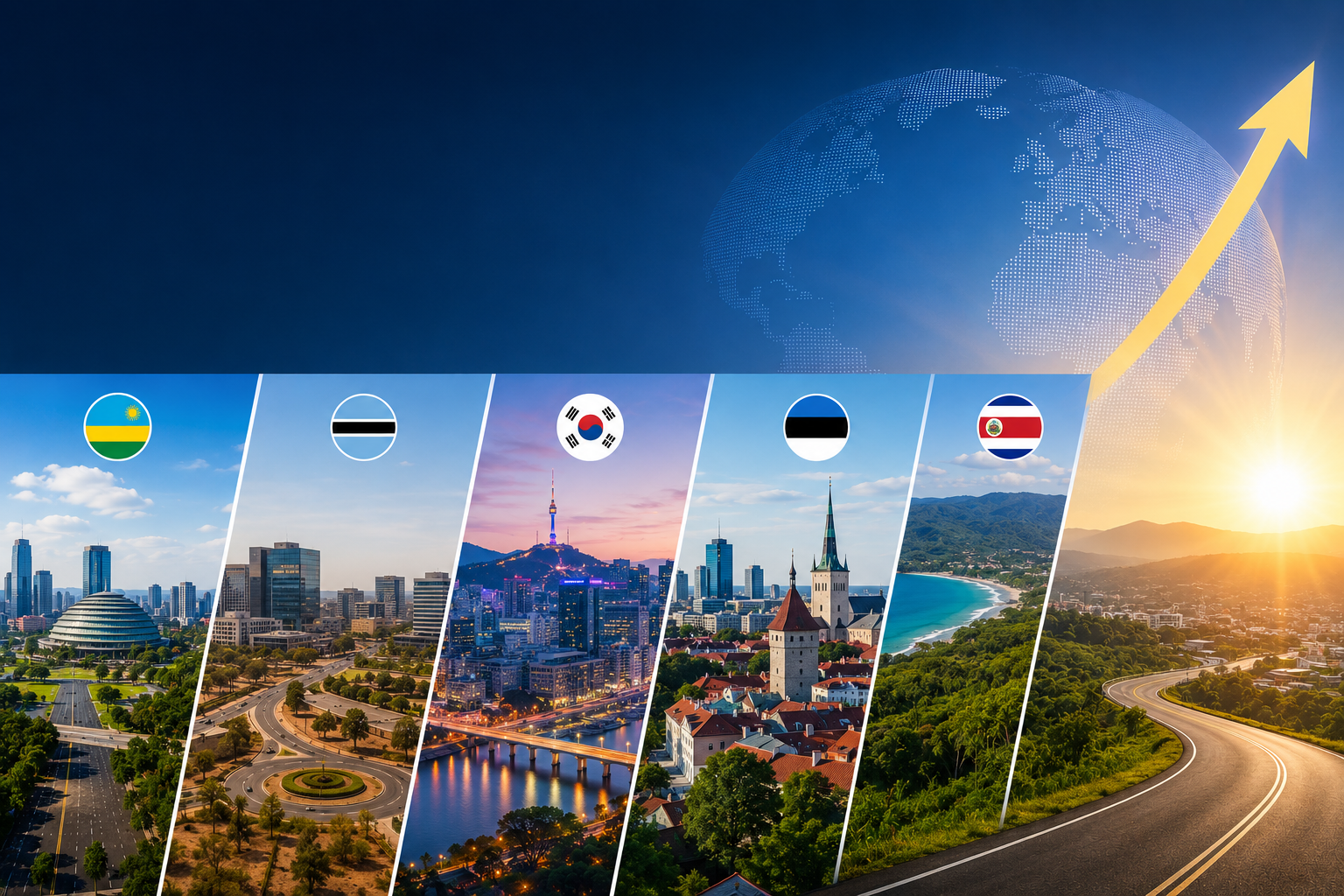
The conventional story about poor countries goes like this: they lack resources, they lack institutions, too much corruption — and so they remain poor. It’s a story that feels true because it actually describes so many countries. But it isn’t the whole truth. A handful of countries have quietly broken the pattern, turning poverty into prosperity within a generation or two. They didn’t get lucky. They made deliberate choices.
Here are five of them — and the specific things each one did differently.
Rwanda: Governing Its Way Out of Catastrophe
Thirty years after the genocide, Rwanda is one of Africa’s fastest-growing economies, posting GDP growth of 8.9% in 2024 and 9.4% in 2025. That number would be impressive for any country. For one rebuilding from near-total collapse, it demands explanation.
The answer isn’t aid. It’s governance. Rwanda invested heavily in anti-corruption infrastructure, merit-based civil service, and long-horizon planning through Vision 2050, which targets high-income status within a generation. President Kagame’s government streamlined business registration, slashed bureaucratic red tape, and created accountability structures that most African governments still resist. The result: over half a million new jobs created year-on-year, a recovering agricultural sector, and rising domestic investment.
Rwanda proves that the starting point matters far less than the institutional choices made after it.
Botswana: Not Cursed by Diamonds — Because It Chose Not to Be
Sub-Saharan Africa is full of resource-rich countries that got poorer as they extracted more. Botswana is the exception. When diamonds were discovered shortly after independence in 1966, the government did something almost unheard of: it managed the revenue transparently, reinvested it into public services, and built institutions designed to outlast any single leader.
Free primary and secondary education. A national university. Scholarships for study abroad. Africa’s first free public antiretroviral program — at a time when HIV was decimating the continent. The diamond revenue was managed through the Bank of Botswana and the Pula Fund, a sovereign wealth vehicle, rather than flowing directly into the political class. By redirecting diamond wealth into human capital rather than elite pockets, Botswana escaped the resource curse that swallowed its neighbors.
Challenges remain — unemployment sits at 27.6% and poverty persists at levels higher than comparable middle-income peers. But the lesson is durable: natural resources are neutral. What determines their impact is who controls them, and in whose interest.
South Korea: The State as Strategic Partner
In 1960, South Korea’s per capita income was lower than Ghana’s. Today it is home to Samsung, Hyundai, and one of the world’s most educated workforces. The transformation — known as the Miracle on the Han River — happened in a single generation.
What drove it was a deliberate industrial policy. Beginning in 1962, the government launched a series of Five-Year Economic Development Plans that identified strategic sectors — steel, shipbuilding, electronics — and channeled credit, training, and policy support into them. The state didn’t compete with the private sector. It partnered with it, on the condition that firms performed. Institutions like the Korea Development Institute provided the research backbone for these plans.
This is the model most Western economists told the developing world to ignore in the 1980s and 1990s. South Korea’s growth is the rebuttal.
Estonia: Building a Country on Code
When Estonia regained independence from the Soviet Union in 1991, its GDP per capita was roughly $3,400. By 2023, it had reached $32,460 — nearly a tenfold increase. The vehicle was a bet almost no one else was willing to make: digitizing the entire state.
Estonia built a legal framework for digital identity before most countries had broadband. The Digital Signatures Act of 2000 gave electronic signatures the same legal weight as physical ones. From there came e-voting, digital tax filing, online business registration, and eventually e-Residency — a program allowing anyone in the world to incorporate a company inside the EU using an Estonian digital identity. The entire architecture is documented and exportable at e-estonia.com, because Estonia has made its model an export product.
One hundred percent of public services are now available online. The government runs leaner. Citizens spend less time in bureaucratic queues. And a small post-Soviet country of 1.3 million people became a global reference point for what governance can look like when it’s built for the 21st century.
Costa Rica: Abolishing the Army to Fund the Future
In 1948, Costa Rica did something no country in the region had done: it abolished its military and redirected the defense budget to education and healthcare. That single decision set the country on a different trajectory.
Today Costa Rica has a 97% literacy rate, one of the lowest poverty rates in Latin America, and an eco-tourism industry generating over $4 billion annually — built on the back of a conservation movement that has restored forest cover to more than 50% of the national territory. The country’s Payments for Ecosystem Services (FONAFIFO) program has paid landowners over €420 million over two decades to protect rather than clear their forests, turning environmental stewardship into an economic asset.
Costa Rica didn’t get rich by extracting. It got rich by preserving — and by trusting that education and health were better investments than weapons.
The Common Thread
Five countries. Five different contexts. But the pattern is the same: deliberate institutional choices, long-term thinking, and a willingness to challenge the conventional development script.
None of them followed the standard playbook handed down by Washington or Brussels. Rwanda governed against corruption when impunity was easier. Botswana reinvested its diamonds when extraction was more profitable. South Korea directed its economy when liberalization was in fashion. Estonia digitized the state when paper was still king. Costa Rica abolished its army when militarism was the norm.
The takeaway isn’t that these countries found a magic formula. It’s that transformation is a choice — and it looks different depending on who’s making it, and for whom.
The countries still waiting for their miracle aren’t waiting for resources. They’re waiting for leadership willing to make that choice.
Louverture Cafe explores the structural forces shaping the developing world — and the people, policies, and ideas working to change them. Read our analysis of why Haiti remains in political crisis and how entrepreneurs are driving transformation from within. If this post made you think, share it — and subscribe to read more.