Before diving into the darker chapters of Haiti’s history, it’s worth remembering that the country has not always been…well, so dark. Despite everything it faced after independence, at internationally and internally, Haiti’s steep socio-economic decline only began in the late 1970s. That slide led to the Haiti the world knows today: poorest nation in the western-hemisphere, gang controlled, frequent government turnovers,..ect. Yet up until the mid-1970s, Haiti was one of the Caribbean’s most popular tourist destinations. The country attracted celebrities like Ernest Hemingway, Mick Jagger, Richard Morse. In December 1975, Bill and Hillary Clinton spent part of their honeymoon on the island, on a trip gifted by their banker friend.
Read more: Haiti was once the honeymoon destination for Hollywood’s elite. What happened?
To many outsiders, Haiti looks permanently broken. It isn’t. It’s a country caught in a cycle with identifiable causes, and I believe every one of them can be broken. No single factor explains how Haiti got here, but three stand out.
History: A Revolution That Never Settled Its Own Questions
After defeating Napoleon’s army in fall of 1803, formerly enslaved people declared and celebrated Haiti’s independence on January 1, 1804. It remains the only successful slave revolution in history, and it created the first nation in the Americas where every man, woman, and child was free (literally).
The founders were united by a common enemy, but not by a common plan. From the moment independence was won, two questions divided them: who should rule, and who should own the land.
The answers came through force. Jean-Jacques Dessalines, the first head of state, was assassinated in 1806, largely over his attempts to redistribute land away from a rising landowning elite. After his death, the country split in two, with Henri Christophe ruling the north and Alexandre Pétion the south, and it stayed divided until 1820.
That set the template for the next two centuries. Power changes hands through confrontation rather than consensus, and the losers rarely accept the result. A striking number of Haiti’s heads of state have been overthrown, exiled, or killed. And as in many countries with persistently high unemployment and low living standards, it has always been easy to inflame the population and spark unrest. Forces both inside and outside the country have long understood this, and exploited it.
Foreign Influence: Real, but Often Overstated
You will often hear that foreign powers, chiefly the United States, France, and Canada, are the main cause of Haiti’s instability. The argument has real merit. But it also gets exaggerated, and the exaggeration undermines it.
Haiti has certainly been on the receiving end of some terrible foreign policy decisions by France and United States, and several have left lasting damage on its development. The most consequential include:
The independence debt.
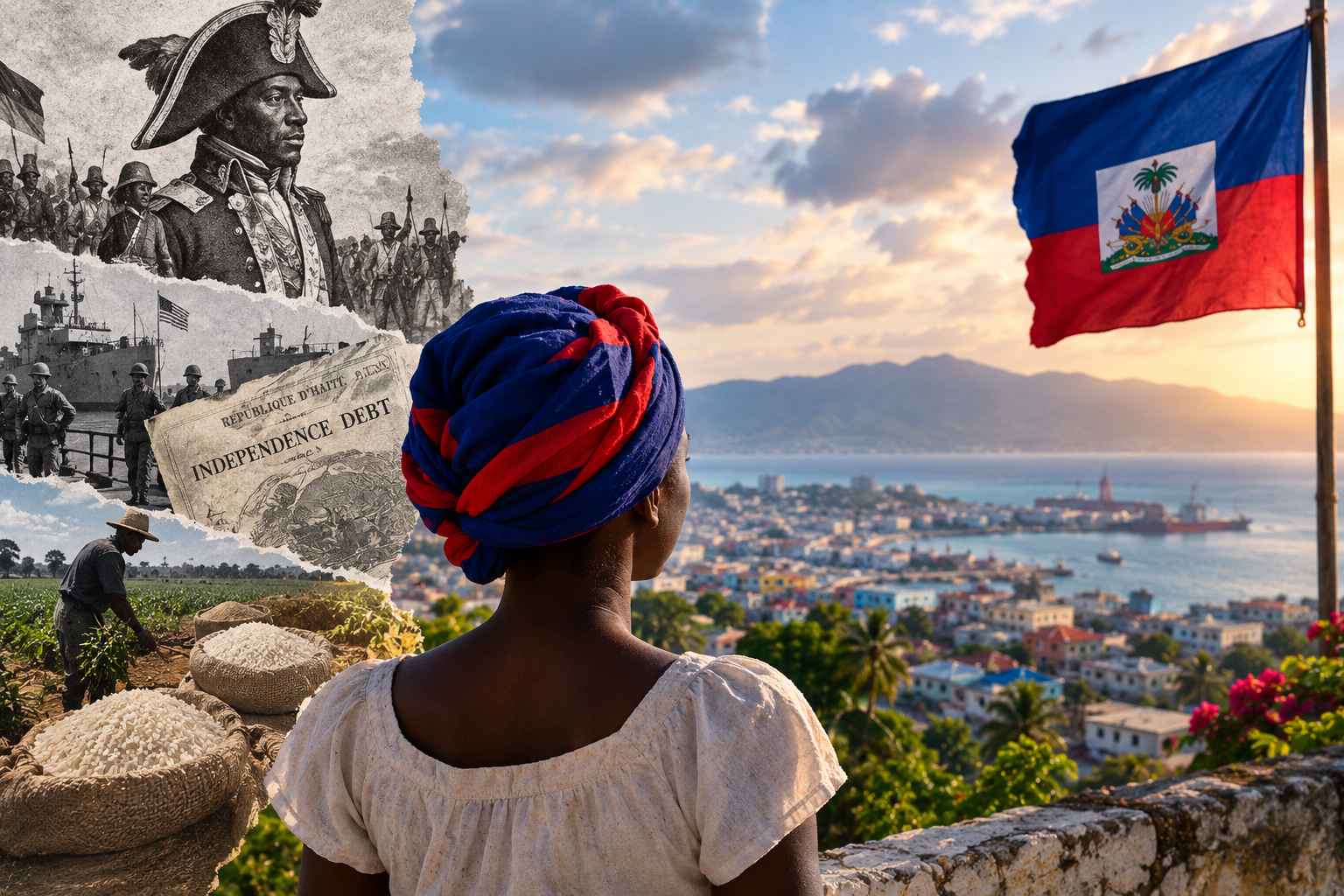
In 1825, backed by warships, France demanded 150 million francs to “indemnify” former slaveholders. In other words, Haitians were made to pay for their own freedom. The country didn’t finish paying off that debt, and the loans taken out to cover it, until 1947 (My father was born in 1950). Had that money gone into Haiti’s future instead (roads, schools, hospitals), the country would have been far better prepared for what came next. When a series of hurricanes struck in the 1950s, most notably Hurricane Hazel in 1954, Haiti had little capacity to respond. And that marked the beginning of its long dependence on foreign aid.
A 2022 New York Times investigation, “The Ransom Project,” found that Haiti paid roughly $560 million over about seven decades, money that could have added $22 billion to $44 billion to its economy in today’s terms. Without the debt, and all else being equal, the Times estimated that Haitians’ economy could have been on par with that of Colombia or Mexico.
Occupation, and picking and removing leaders.
The U.S. occupied Haiti from 1915 to 1934. The occupation was, in large part, a financial operation: Wall Street banks, led by National City Bank (today’s Citigroup), had pushed hard for it. During those years, the U.S. took control of Haiti’s customs revenue and central bank and rewrote its constitution to allow foreign land ownership. Needless to say, those decisions benefited the U.S. long after the Marines left.
In 1986, under pressure from the Reagan administration, Jean-Claude “Baby Doc” Duvalier abruptly fled into exile. He was hardly popular among Haitians, but his sudden departure plunged the country into chaos and years of military rule. Haitians didn’t get a freely elected president until December 1990, when they chose Jean-Bertrand Aristide, an outspoken critic of U.S. policy toward Haiti and the Haitian elite. He was overthrown less than a year after taking office.
Still popular with the Haitian population, Aristide was re-elected in November 2000. In 2004 (during Bush administration), he left the country on a U.S. plane bound for exile. Washington and Paris said he resigned. Aristide called it a kidnapping, and critics, including members of the U.S. Congress, denounced it as a coup d’état. Many link his removal to a demand he made in 2003: that France repay Haiti about $22 billion in restitution for the independence debt. France’s ambassador at the time later told the New York Times that ending that campaign was one benefit of the ouster (Democracy Now!).
Trade policy.
Haiti grew nearly all its own rice until 1980. In the mid-1990s, under pressure from the Clinton administration, it slashed its tariff on imported rice to just 3%. Subsidized American rice flooded the market, local farmers couldn’t compete, and by 2003 about 80% of the rice Haitians ate came from the U.S. (World Hunger News). Clinton himself later apologized for the policy (CEPR).
However damaging these policies were, blaming everything that goes wrong in Haiti on foreign powers is simply wrong and, frankly, self-defeating. When the people of any country come to believe that changing their living conditions is beyond their control, things can only go downhill. These policies were not part of a coordinated plot to keep Haiti down. They are products of shortsighted policy makers. Haiti, like many countries, has simply been an easy target for administrations looking to make their mark, boost their popularity at home to guarantee re-election, keep their party in power, and satisfy their donors. What is often not talked about is how these policies backfire; causing more instability and poverty in the affected countries, then mass migration, therefore more immigration issues for those developed countries.
The Elite
Like many former colonies, Haiti has always had a well-connected elite that controls much of its wealth. In the 19th century, that group was made up largely of the mixed-race descendants of colonists and enslaved women. After independence, the elite realized it didn’t need plantations or slaves to control the country’s resources. It only needed to control the key levers of the economy. So it ran the ports, managed taxes, and filled the top ranks of the military. That military carried out nearly every coup d’état in Haiti until François “Papa Doc” Duvalier, who built his own militia, the Tontons Macoutes, to keep himself in power.
Duvalier exploited the color and class resentments surrounding this elite to build his dictatorship, which began in 1957. Under his regime, much of the old elite left the country. Over time, merchant families of Lebanese, Syrian, and Palestinian descent filled the vacuum.
Its makeup has changed. Its function hasn’t. A handful of families control ports, imports, banking, and key distribution channels, which makes them the natural point of contact for any foreign government or company seeking influence. Apart for making money, they don’t much of interest in the country. They live in Haiti to run their businesses, but their families live overseas. Their kids attend prestigious universities in developed countries. They are widely accused of swaying elections in their favor, manufacturing chaos (funding gangs, stoking protests) whenever a government stops serving their interests, and helping engineer coups. Members of this elite are widely reported to have bankrolled the 1991 coup that sent Aristide into exile.
Breaking the Cycle
History, foreign influence, and a self-serving elite have reinforced each other for two centuries. But a cycle that was built can be broken. Despite everything, Haitians keep organizing: civil society coalitions, grassroots movements, and local organizations continue to push for a Haitian-led future. The causes above point directly to what has to change.
Fifty years ago, the world came to Haiti for its beauty, its art, and its spirit. None of that has disappeared. What Haiti lacks is not potential but a system that lets its people benefit from it. That system won’t come from foreign aids. It will come from Haitians who refuse to accept that their future is beyond their control.
Louverture Cafe takes a structural view of the forces shaping the developing world. Read our piece on what Toussaint Louverture’s story reveals about empire and resistance, and explore how the diaspora can drive a different future. Subscribe — this conversation matters.